
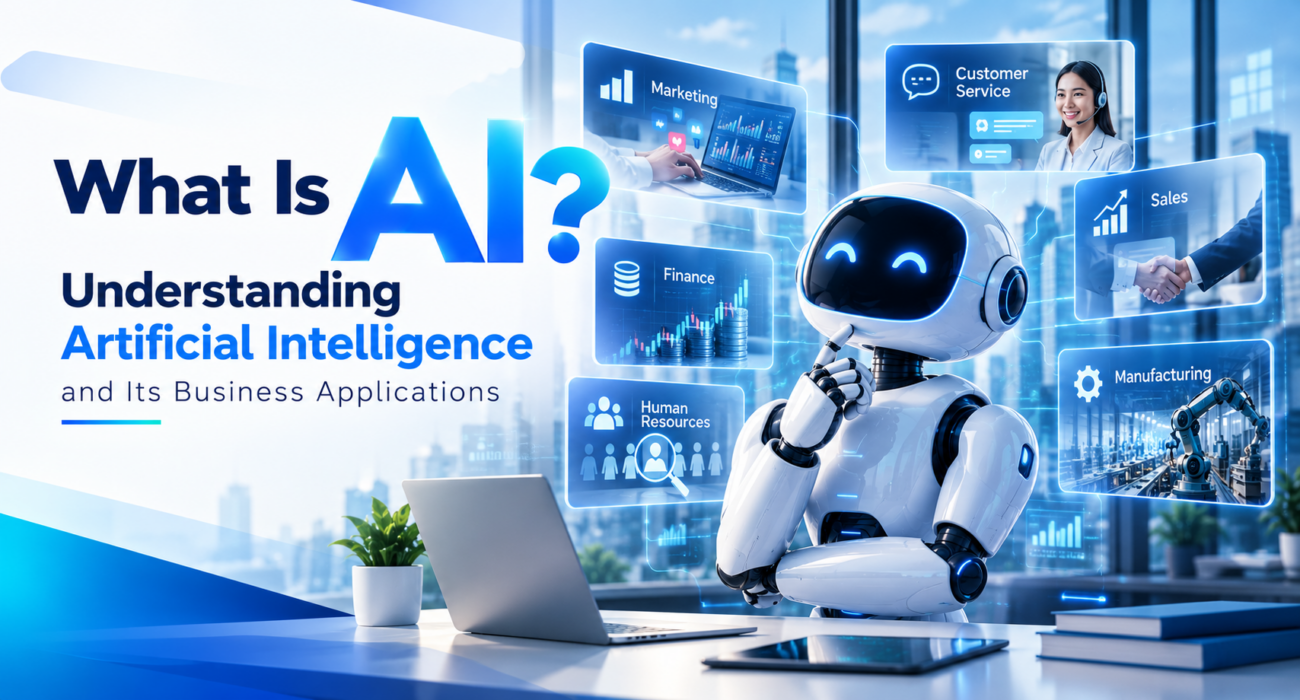
Artificial Intelligence (AI) is transforming the way businesses operate, make decisions, and serve customers. From automated customer support and personalized marketing to financial analysis and predictive maintenance, AI is becoming an important technology for organizations looking to improve efficiency and remain competitive in the digital era.
As businesses generate increasing amounts of data and adopt new digital tools, understanding what AI is, how Artificial Intelligence works, and how businesses can use AI effectively has become more important than ever.
In this article, we explore the fundamentals of AI, explain how it works, and provide practical examples of AI applications across different business functions.
What Is AI?
AI, or Artificial Intelligence, is a field of technology that enables computers and software systems to perform tasks that typically require human-like intelligence. These tasks include learning, analyzing information, recognizing patterns, understanding language, generating content, and supporting decision-making.
AI systems use data, algorithms, and computational models to produce outputs based on the information they receive. Depending on the application, an AI system may identify patterns, make predictions, recommend actions, or generate text and images.
Examples of AI technologies used in everyday life and business include:
Chatbots that answer customer questions
Recommendation systems that suggest products or content
Facial recognition systems
Speech recognition and speech-to-text tools
Generative AI tools that create text, images, and other content
Fraud detection systems that identify unusual transactions
Predictive analytics tools that support business planning
AI is not limited to robots. It can also operate behind the scenes in software applications, websites, enterprise systems, and digital services.
How Does Artificial Intelligence Work?
Although AI technologies can be complex, the general process can be explained in five steps.
1. Data Collection
AI systems need data to learn patterns and generate useful outputs. Depending on the application, this may include customer records, sales transactions, documents, images, audio, or information from internal business systems.
2. Data Processing
The collected data is processed to identify relevant information, relationships, and patterns. Data quality is important because incomplete, inaccurate, or biased data can affect the results.
3. Learning and Model Development
Some AI systems use Machine Learning (ML) to learn patterns from examples rather than relying entirely on manually programmed rules.
Other approaches, including deep learning, use more complex models to process information such as images, speech, and natural language.
4. Generating Results
Once an AI model is ready to use, it can process new inputs and generate outputs. These may include predictions, recommendations, classifications, summaries, or responses to questions.
5. Evaluation and Improvement
AI performance should be evaluated regularly. Depending on the system, improvements may involve updating the model, refining instructions, correcting data, or adjusting the workflow in which AI is used.
Human review remains important, especially when AI outputs influence financial decisions, customer experiences, or other high-impact business activities.
What Is the Difference Between AI and Machine Learning?
AI and Machine Learning are closely related, but they do not mean exactly the same thing.
Artificial Intelligence (AI) is the broader field focused on building systems that can perform tasks associated with human-like intelligence.
Machine Learning (ML) is a subset of AI that enables systems to learn patterns from data and use those patterns to make predictions or decisions.
For example, a customer service system may use AI to understand questions and generate responses. Machine Learning may help the system classify customer requests or predict which issues are likely to require additional support.
In simple terms:
AI: The broader field of intelligent computer systems.
Machine Learning: A technique that allows systems to learn from data.
Deep Learning: A specialized form of Machine Learning that uses multi-layer neural networks.
Generative AI: AI designed to generate new content, such as text, images, audio, or code.
Understanding these distinctions helps organizations choose technologies that match their business objectives.
6 Examples of AI Applications in Business
AI can support a wide range of business functions, from marketing and sales to finance, human resources, and manufacturing.
The most effective applications are those that address specific business challenges and produce measurable results.
1. AI in Marketing
AI helps marketing teams analyze customer behavior, understand audience preferences, and improve campaign planning.
Common applications include:
Analyzing customer behavior and engagement
Segmenting audiences based on relevant data
Recommending products and services
Identifying content trends and customer interests
Assisting with content creation and campaign planning
Analyzing campaign performance
For example, a marketing team can use AI tools to generate initial content drafts, analyze campaign data, or identify audience segments for more relevant messaging.
Business benefit: More informed marketing decisions, improved workflow efficiency, and better-targeted campaigns.
AI-generated content should still be reviewed for accuracy, brand consistency, originality, and compliance with relevant requirements.
2. AI in Customer Service
AI-powered chatbots and virtual assistants can help businesses respond to common customer inquiries and provide information around the clock.
Typical applications include:
Answering frequently asked questions
Providing product and service information
Guiding customers through basic processes
Checking order or service status when connected to relevant systems
Routing complex inquiries to human agents
Summarizing customer conversations
For example, an online service provider could use an AI chatbot to answer common questions about its services while transferring complicated technical issues to a support team.
Business benefit: Faster responses, more consistent customer support, and reduced workload for service teams.
Businesses should establish clear escalation procedures so customers can reach a human representative when necessary.
3. AI in Sales
AI can help sales teams identify opportunities, prioritize leads, and understand customer purchasing patterns.
Common applications include:
Lead scoring and prioritization
Sales forecasting
Customer behavior analysis
Personalized product recommendations
Sales conversation summaries
Identification of potential cross-selling opportunities
For example, a sales team may use AI to analyze historical sales data and identify leads that share characteristics with previous successful customers.
The team can then use these insights to prioritize outreach and allocate resources more effectively.
Business benefit: Better sales planning, improved lead management, and more informed decision-making.
AI recommendations should support the sales team rather than replace professional judgment or direct customer understanding.
4. AI in Finance
Financial institutions and business finance teams can use AI to analyze large volumes of data, identify unusual patterns, and support risk assessment.
Applications include:
Detecting potentially fraudulent transactions
Analyzing financial and operational risks
Supporting credit risk assessment
Identifying unusual transaction patterns
Forecasting cash flow and financial trends
Automating document classification and data extraction
For example, an AI-powered monitoring system can flag transactions that differ significantly from established patterns for further investigation.
Business benefit: Faster analysis, improved anomaly detection, and more efficient financial workflows.
AI should not be treated as a guarantee of fraud detection or financial accuracy. Organizations need appropriate validation, data protection, human oversight, and controls for decisions that affect customers.
5. AI in Human Resources (HR)
AI can support HR teams throughout recruitment, employee development, and workforce planning.
Common applications include:
Matching candidate qualifications against job requirements
Assisting with recruitment administration
Answering routine employee questions
Analyzing workforce trends
Recommending relevant training programs
Identifying potential skill gaps
For example, an organization can use AI to help map employee skills against the competencies required for future projects and identify areas where additional training may be beneficial.
Business benefit: More efficient HR processes, improved workforce planning, and better-informed employee development initiatives.
Because HR decisions affect people’s careers, organizations should monitor AI systems for bias and ensure that recruitment and employment decisions receive appropriate human review.
6. AI in Manufacturing
Manufacturing companies can apply AI to production data, equipment monitoring, and quality control.
Examples include:
Detecting product defects through computer vision
Monitoring equipment performance
Supporting predictive maintenance
Forecasting production demand
Identifying production bottlenecks
Improving quality inspection processes
For example, a manufacturer may use AI to analyze equipment sensor data and identify patterns associated with potential mechanical problems.
This information can help maintenance teams investigate issues before they lead to significant downtime.
Business benefit: Better visibility into production processes, more efficient inspections, and improved maintenance planning.
The results depend on factors such as sensor quality, data availability, system integration, and the reliability of the AI model.
What Are the Benefits of AI for Businesses?
When implemented appropriately, AI can help organizations improve their operations and make better use of available information.
1. Improved Operational Efficiency
AI can assist with repetitive or time-consuming tasks, allowing employees to focus on work that requires creativity, critical thinking, and human interaction.
2. Faster Data Analysis
AI can process large datasets and identify patterns that may be difficult to detect through manual analysis alone.
3. Better Decision Support
AI-generated insights, forecasts, and recommendations can provide additional information for business leaders and teams when making decisions.
However, AI outputs should be evaluated against reliable data and relevant business context.
4. Enhanced Customer Experience
AI-powered chatbots, recommendation systems, and personalization tools can help businesses deliver more relevant information and services.
5. Greater Business Agility
AI can help organizations explore new workflows, respond to changing customer needs, and test new service models.
6. New Business Opportunities
When combined with appropriate software, data, and business expertise, AI can enable new digital services, improve existing products, and support innovation.
The actual benefits depend on the use case, implementation quality, operating costs, and the organization’s ability to integrate AI into its workflows.
How Can Businesses Get Started with AI?
Organizations do not need to begin with a large or complex AI project. A practical approach is to start with a clearly defined business problem and expand gradually.
Step 1: Identify a Business Problem
Determine which processes are time-consuming, repetitive, costly, or dependent on extensive data analysis.
Examples include customer inquiries, document processing, sales reporting, and content production.
Step 2: Assess Data Readiness
Review whether the organization has sufficient, relevant, and reliable data for the intended use case.
Businesses should also consider data privacy, access permissions, security, and applicable legal requirements.
Step 3: Select the Right AI Solution
Choose technology based on the problem rather than adopting AI simply because it is popular.
Depending on the task, the appropriate solution may be a generative AI assistant, a predictive analytics model, a chatbot, or a conventional automation tool.
Not every business process requires AI.
Step 4: Start with a Small Pilot Project
Test the solution within a limited workflow before expanding it across the organization.
For example, a company could pilot an AI assistant for internal document searches or use AI to help summarize customer service conversations.
Step 5: Measure Business Results
Define measurable indicators before implementation, such as:
Time saved per task
Reduction in processing costs
Response time
Error rates
Customer satisfaction
Employee adoption
Return on investment (ROI)
These indicators help organizations determine whether the solution delivers meaningful value.
Step 6: Improve and Scale
Use pilot results to refine the workflow, address limitations, and determine whether the solution should be expanded.
Successful implementation also requires employee training, clear governance, and ongoing performance monitoring.
Will AI Replace Human Employees?
One of the most common questions about Artificial Intelligence is whether AI will replace people at work.
The impact varies by occupation and task. AI can automate certain activities, assist with complex workflows, and change the skills required for many roles. However, human judgment, contextual understanding, communication, creativity, and accountability remain important in many business settings.
Rather than viewing AI as a complete replacement for people, organizations can consider how AI and human expertise can work together.
Employees who understand how to use AI appropriately may be better equipped to analyze information, improve productivity, and focus on higher-value responsibilities.
This is why workforce development, including Upskilling and Reskilling, is an important part of AI adoption.
Organizations should prepare employees to work effectively with new technologies while ensuring that accountability and decision-making responsibilities remain clear.
Why AI Implementation Requires the Right Technology Partner
Introducing AI into an organization involves more than selecting an AI tool. Businesses also need to consider software compatibility, data quality, system integration, cybersecurity, scalability, and ongoing maintenance.
A suitable technology partner can help organizations:
Assess business requirements and technical readiness
Identify practical AI use cases
Integrate AI into existing software and workflows
Develop or customize business applications
Improve data management and system connectivity
Evaluate performance and support future improvements
For organizations with specialized requirements, custom software development may provide a way to integrate AI capabilities into existing business processes rather than relying exclusively on standalone tools.
The right approach depends on the organization’s objectives, budget, technical environment, and risk profile.
How Techsoft Holding Supports Digital Transformation
Technology creates the greatest value when it addresses real business needs.
Techsoft Holding provides technology-related services, including IT Outsource and Project-based Development, to support organizations with their software development and digital initiatives.
Businesses exploring AI adoption can begin by identifying operational challenges, reviewing existing systems, and determining where software improvements or AI-enabled workflows could create measurable value.
With a clear implementation strategy, organizations can take a practical approach to digital transformation while preparing their teams for changing technology requirements.
Conclusion: What Is AI and Why Does It Matter to Business?
Artificial Intelligence (AI) is a technology that enables computer systems to perform tasks such as learning from data, recognizing patterns, generating content, and supporting decision-making.
Today, AI has practical applications across many business functions, including Marketing, Sales, Customer Service, Finance, Human Resources, and Manufacturing.
When implemented appropriately, AI can improve efficiency, accelerate data analysis, support better decisions, and create new opportunities for innovation. However, successful adoption requires more than technology alone. Organizations must also consider data quality, security, human oversight, employee skills, and measurable business outcomes.
The best starting point is to identify a clear business problem, select an appropriate solution, test it on a small scale, and evaluate its impact before expanding.
Ultimately, AI is not just about adopting new technology. It is about using technology strategically to help people work more effectively and businesses grow sustainably.