
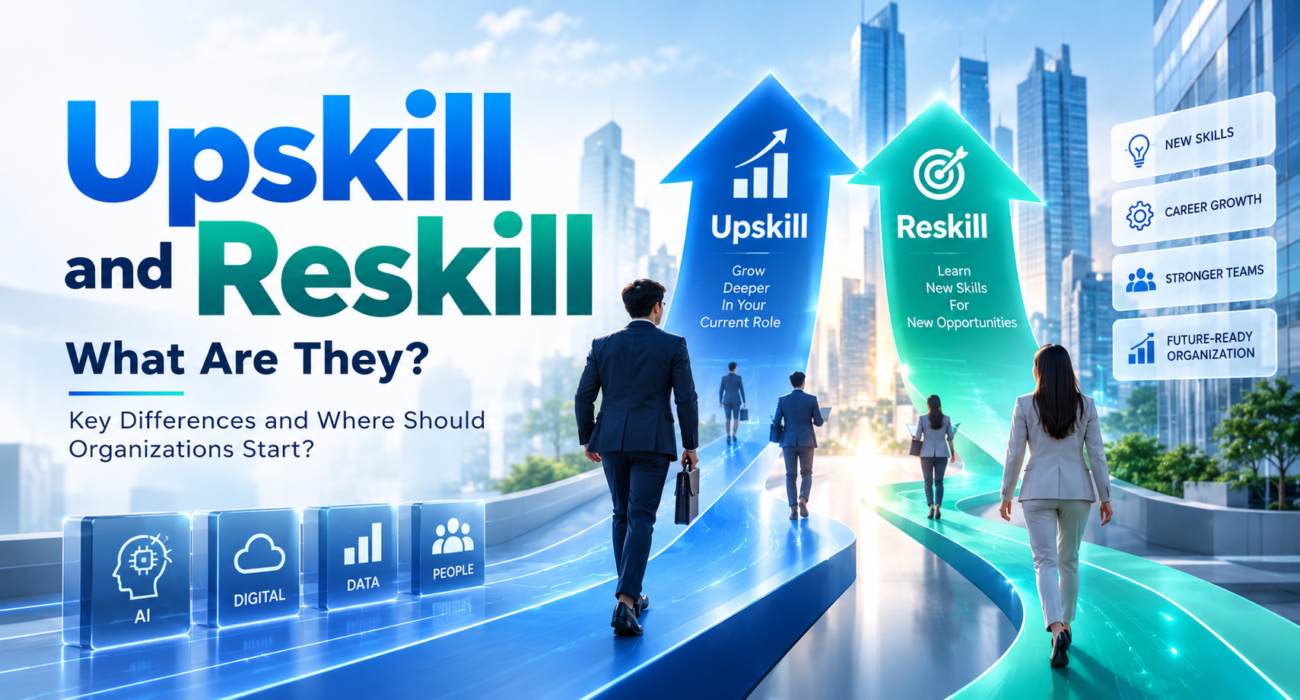
In an era of rapid technological change, particularly with the rise of Artificial Intelligence (AI), Automation, and Digital Transformation, the skills organizations need from their employees are constantly evolving. Building a workforce that can learn, adapt, and grow has become essential to maintaining business competitiveness.
This is why Upskilling and Reskilling have become important strategies for workforce development. Both approaches help organizations prepare employees for changing business needs, emerging technologies, and new job requirements.
But what are upskilling and reskilling? How are they different? And which approach should organizations prioritize?
In this article, we explore the definitions, key differences, business benefits, and practical steps organizations can take to develop their workforce effectively.
What Are Upskilling and Reskilling?
Upskilling and Reskilling are workforce development strategies designed to help employees acquire the skills they need to meet evolving business requirements.
Although both focus on learning and professional development, they serve different purposes.
What Is Upskilling?
Upskilling means developing or improving skills related to an employee’s current role. The goal is to help employees perform their existing responsibilities more effectively while adapting to new tools, technologies, and working methods.
For example, a Marketing professional who already manages social media campaigns might develop additional skills in:
AI-powered content creation
Data Analytics
Marketing Automation
Search Engine Optimization (SEO)
Social Media Analytics
The employee remains in the Marketing field but gains additional capabilities that enable them to deliver better results and handle more complex tasks.
In simple terms: Upskilling means becoming better at your current job.
What Is Reskilling?
Reskilling means learning new skills to transition into a different role or career path. It is particularly useful when existing job responsibilities change, new positions emerge, or organizations need employees with different capabilities.
For example, a Customer Service employee might receive reskilling training in:
Data Analytics
Business Analysis
Digital Operations
AI Tools
Software Testing
These new skills could help the employee transition into a different role within the organization.
In simple terms: Reskilling means learning new skills to move into a different role.
What Is the Difference Between Upskilling and Reskilling?
The main difference lies in the objective of the learning process.
| Aspect | Upskilling | Reskilling |
|---|---|---|
| Objective | Improve skills for the current role | Develop skills for a new role |
| Career direction | Continue in the same field | Potentially transition to a different field |
| Skills developed | Advanced or additional skills | A new set of skills |
| Example | Marketing Executive → AI Marketing Specialist | Customer Service Representative → Data Analyst |
| Best suited for | Roles that require enhanced capabilities | Roles affected by changing business needs |
The difference can be summarized simply:
Upskilling means improving along the same career path.
Reskilling means preparing for a new career path or job role.
However, these strategies are not mutually exclusive. Many organizations use both approaches as part of an integrated workforce development plan.
Why Are Upskilling and Reskilling Important for Organizations?
Workforce development is not solely an HR responsibility. It directly affects an organization’s productivity, adaptability, and ability to compete.
1. Adapting to Technological Change
Technologies such as AI and Automation are transforming how many industries operate. Employees must continuously learn new tools and working methods to remain effective.
Employee upskilling enables organizations to introduce new technologies while helping employees improve their performance in existing roles.
2. Improving Productivity
When employees develop the right skills, they can use tools and processes more effectively, reduce repetitive work, and focus on higher-value responsibilities.
For example, using AI to summarize information, analyze documents, or generate initial content drafts can reduce time spent on routine tasks and give employees more time for critical thinking and creative work.
3. Closing Skill Gaps
A Skill Gap is the difference between the skills employees currently possess and the skills an organization needs.
For example, a company may want to use Data Analytics to improve business planning, but its employees may lack the necessary analytical skills.
The organization can address this gap through targeted Training, Upskilling, or Reskilling programs.
4. Supporting Employee Career Growth
Skills development helps employees identify opportunities for professional growth.
Organizations can establish clear career paths and define the competencies required for each position, helping employees understand which skills they need to develop to progress to the next level.
5. Reducing Dependence on External Recruitment
When organizations can develop existing employees to fill emerging skill requirements, they may reduce the need to recruit externally for certain positions.
This approach can also help retain institutional knowledge, preserve valuable experience, and create more internal career opportunities.
Examples of Upskilling and Reskilling Across Departments
Upskilling and reskilling can be applied across different business functions.
Marketing
Upskilling: Learning AI Content Creation, SEO, Data Analytics, and Marketing Automation.
Reskilling: Transitioning from Marketing Coordinator to Digital Marketing Specialist.
Human Resources (HR)
Upskilling: Developing skills in HR Analytics, HR Technology, and AI Tools.
Reskilling: Transitioning from HR Operations to People Analytics.
Customer Service
Upskilling: Learning CRM systems, AI Chatbots, and Customer Data Analysis.
Reskilling: Transitioning from Customer Service to Customer Success or Data Support.
IT
Upskilling: Enhancing skills in Cloud Computing, Cybersecurity, AI, or DevOps.
Reskilling: Transitioning from System Administrator to Cloud Engineer or DevOps Engineer.
These examples demonstrate that workforce development does not always require employees to change jobs. Organizations can create learning pathways that match employees’ existing capabilities, career goals, and business needs.
Where Should Organizations Start with Upskilling and Reskilling?
The key question is not simply whether to upskill or reskill. It is which skills the organization will need in the future.
Organizations can start with the following steps.
1. Analyze Business Objectives
Before launching a training program, organizations should identify their strategic priorities.
For example:
Does the organization plan to adopt AI?
Is Digital Transformation a priority?
Does the business need to reduce costs or improve productivity?
Is the organization planning to launch new products or services?
These objectives help determine which capabilities employees need to develop.
2. Identify Skill Gaps
Assess employees’ existing skills and compare them with the skills required to achieve business objectives.
For example:
Current skills: Excel, Reporting, Basic Data Analysis
Required skills: Power BI, Advanced Analytics, AI-Assisted Analysis
This gap can become the foundation of a targeted upskilling plan.
3. Group Employees by Learning Needs
Not every employee needs to attend the same training program.
Organizations can group employees according to their roles, current skill levels, and responsibilities, such as:
Beginner
Intermediate
Advanced
Manager / Leader
This approach helps ensure that training is relevant to each participant.
4. Choose the Right Training Format
Organizations can develop employee skills through different learning formats, including:
Classroom Training
Online Training
Workshops
Hands-on Training
Coaching
Mentoring
Learning Platforms
On-the-Job Training
For Technology-related skills, workshops and hands-on training can help employees practice what they learn and apply it to real-world tasks.
5. Measure Training Outcomes
Training effectiveness should be measured by more than attendance.
Organizations can track indicators such as:
Pre-training and post-training assessment scores
Number of employees who meet skill requirements
Reduction in task completion time
Improvements in productivity
Increase in work output
Application of newly acquired skills on the job
The key question is not simply, “Did employees attend the training?” but “What improved after the training?”
Upskilling and Reskilling in the AI Era
The rise of Generative AI is changing how many tasks are performed across industries. While AI can automate certain activities, employees who know how to use AI effectively may be able to work faster, improve quality, and produce greater value.
Organizations should therefore develop a balanced combination of Technology Skills and Human Skills.
Technology Skills
AI Literacy
Data Analytics
Digital Tools
Cybersecurity
Automation
Cloud Technology
Human Skills
Critical Thinking
Problem Solving
Communication
Creativity
Collaboration
Leadership
This combination helps employees do more than simply operate new tools. It enables them to apply technology thoughtfully, solve problems, and make better decisions.
A Training Center can play an important role in helping organizations develop workforce capabilities, particularly when they need a structured approach to upskilling and reskilling.
Training programs can be tailored to different roles, skill levels, and business objectives, including:
IT Training
Software Development
AI Training
Digital Skills
Data Analytics
Cybersecurity
Leadership
Soft Skills
Organizations can also implement Corporate Training programs that incorporate real business challenges and workplace scenarios into the learning process.
This approach helps employees connect theoretical knowledge with practical application and makes it easier to transfer newly acquired skills to their daily responsibilities.
Conclusion: Upskilling vs. Reskilling
Upskilling focuses on improving existing skills to perform a current role more effectively, while Reskilling focuses on acquiring new skills to prepare for a different role or career path.
Both strategies are essential for organizations navigating rapid technological change, particularly as AI and Digital Transformation reshape the workplace.
For organizations getting started, a practical approach is to follow these steps:
Analyze business objectives → Identify skill gaps → Define required skills → Deliver training → Apply learning in the workplace → Measure results → Continuously improve.
Effective upskilling and reskilling do not end when a training session finishes. Their real value comes from measurable improvements in workplace performance and the organization’s ability to adapt.
Techsoft Holding supports organizations through Training, Technology, and Software Development services, helping businesses strengthen workforce capabilities and prepare for an evolving digital landscape.